
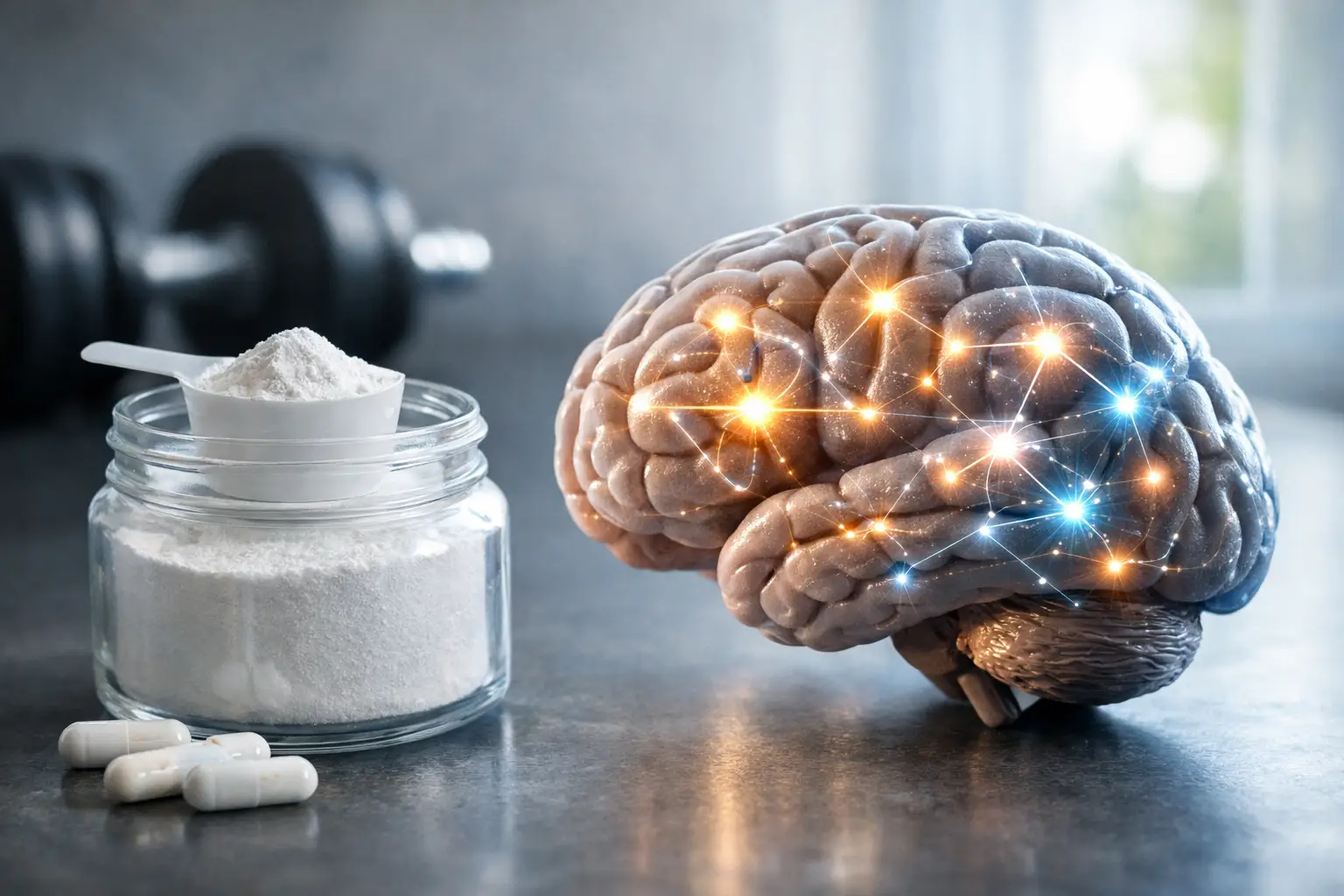
You may know creatine as the supplement lifters take for stronger workouts and better recovery. But the same compound that helps muscles recycle energy also plays a role in the brain. That has made creatine brain benefits an increasingly interesting topic for anyone dealing with mental fatigue, poor sleep, demanding workdays, or the natural energy changes that can come with aging.1.2
Creatine is not a stimulant, it does not work like coffee, and it is unlikely to create a sudden burst of focus. Its value is more foundational: helping cells maintain available energy when demand is high. The research is promising, but the benefits are not identical for everyone.
Why creatine matters to the brain
Your brain uses an enormous amount of energy, even while you are sitting still. It depends on a steady supply of ATP, the cellular fuel that powers everything from signaling between nerve cells to attention, memory, and decision-making.3
Creatine helps replenish ATP quickly. Your body makes some creatine in the liver and kidneys, and you also get it from foods such as red meat, pork, poultry, and fish. It is then stored largely in muscle, though the brain also contains creatine and uses its energy-buffering system.4
When you are sleep-deprived, mentally overloaded, exercising intensely, under-fueled, or following a low-meat or plant-based diet, that energy system may be under greater pressure. This is where supplemental creatine may be most useful.5.6
Creatine brain benefits supported by research
The strongest evidence does not say that creatine turns everyone into a sharper, faster thinker. Instead, studies suggest it may support certain aspects of cognition, particularly when the brain is working under stress or when a person starts with lower creatine stores.7
It may support memory and reasoning
Some clinical research has found modest improvements in short-term memory, recall, and reasoning after creatine supplementation. These effects appear more consistently in vegetarians and vegans, who generally consume less dietary creatine, as well as in older adults.8.9
That does not mean people who eat meat cannot benefit. It simply means the starting point matters.10 If your creatine stores are already well supplied through diet, the cognitive change may be subtle or difficult to notice.
It may help during sleep loss or mental strain
A poor night of sleep can make even simple tasks feel harder. Small studies suggest creatine may help preserve aspects of cognitive performance during sleep deprivation, including attention and reaction time.11.12 This does not make it a substitute for sleep. Consistent sleep remains one of the most powerful tools for brain health, mood, and metabolic balance.
Still, creatine could be a practical layer of support during temporarily demanding periods, such as travel, a new baby, intense training, exam preparation, or a high-pressure work project. Think of it as helping the brain’s energy backup system, not erasing the need for recovery.
It may be especially relevant for adults over 50
Age-related changes in muscle, energy metabolism, physical activity, and food intake can all influence how people feel day to day. Creatine is already well studied for supporting strength and lean mass when paired with resistance training in older adults.13.14 Its possible cognitive benefits are an added area of interest.
For adults over 50 who feel both physically and mentally drained, creatine may be worth discussing with a qualified healthcare professional, especially if resistance training is part of the plan. Improving muscle function, movement confidence, and overall activity can also support long-term brain health indirectly.
It could be useful for people eating little or no animal protein
Because animal foods are the main dietary source of creatine, vegetarians and vegans tend to have lower baseline stores. Supplementation may raise levels more noticeably in this group, which may explain why some studies see clearer cognitive effects.
For plant-based eaters, creatine can be one straightforward way to support workout performance and potentially mental energy without relying on caffeine or highly processed energy products.
What creatine cannot promise
The excitement around brain health supplements can get ahead of the science. Creatine is not a proven treatment for dementia, depression, ADHD, concussion, and it is not established as a treatment for neurological conditions. Research in several of these areas is ongoing, but it is too early to treat creatine as medical therapy.15.16
It is also not a replacement for the basics that shape cognitive health: adequate sleep, stable blood sugar, regular movement, protein and fiber-rich meals, stress management, social connection, and treatment for conditions such as sleep apnea, thyroid disease, anemia, anxiety, or depression.
If brain fog is new, severe, worsening, or accompanied by confusion, weakness, speech changes, chest pain, or a sudden severe headache, seek prompt medical care rather than trying to supplement your way through it.
How to take creatine for mental and physical energy
Creatine monohydrate is the form with the most research behind it.17 It is widely available, generally affordable, and does not need a complicated stack to work.
For most adults, a daily dose of 3 to 5 grams is a reasonable approach. You can take it with a meal, in a smoothie, or mixed into water. Timing matters far less than consistency, because creatine works by gradually increasing body stores.
A loading phase, often 20 grams per day divided into several doses for about five to seven days, can saturate stores faster. It is optional. Many people prefer to skip it because it can cause temporary bloating or stomach discomfort, and daily use at 3 to 5 grams will still build stores over several weeks.
Choose a plain, third-party-tested creatine monohydrate powder when possible. Fancy blends may add sweeteners, stimulants, or unnecessary ingredients without offering better results. Ingredient transparency matters, especially if you are using supplements daily.
Side effects and safety considerations
Creatine is one of the most studied sports supplements, and healthy adults generally tolerate it well at standard doses. The most common effects are mild water retention, a small increase in body weight from water stored in muscle, and occasional digestive upset. Splitting the dose or taking it with food can help if your stomach is sensitive.
Creatine does not appear to damage healthy kidneys when used appropriately.18 However, anyone with kidney disease, reduced kidney function, or a condition requiring close fluid or medication management should speak with their clinician first. The same caution applies if you are pregnant, breastfeeding, or taking medications that may affect kidney function.
If you have blood tests while using creatine, tell your clinician. Creatine can raise creatinine, a marker used in standard kidney testing, without necessarily meaning kidney damage.19 Your healthcare team can interpret the result in context.
Is creatine worth trying for brain health?
Creatine makes the most sense when it fits into a larger routine that supports energy from multiple directions. It may be particularly worth considering if you are plant-based, over 50, strength training, frequently mentally taxed, or trying to reduce your dependence on stimulants.
Set realistic expectations. Give a simple creatine monohydrate routine several weeks, pay attention to sleep, mood, focus, training recovery, and digestion, and avoid changing five habits at once. The most useful wellness choices are often the ones that quietly support your capacity to show up with more energy, day after day.
Sources:
- Adhihetty PJ, Beal MF. Creatine and its potential therapeutic value for targeting cellular energy impairment in neurodegenerative diseases. Neuromolecular Med. 2008;10(4):275-90. doi: 10.1007/s12017-008-8053-y. Epub 2008 Nov 13. PMID: 19005780; PMCID: PMC2886719.
- Robert H. Andres, Angélique D. Ducray, Uwe Schlattner, Theo Wallimann, Hans Rudolf Widmer, Functions and effects of creatine in the central nervous system, Brain Research Bulletin, Volume 76, Issue 4, 2008, Pages 329-343, ISSN 0361-9230, https://doi.org/10.1016/j.brainresbull.2008.02.035.
- Lowe MT, Kim EH, Faull RL, Christie DL, Waldvogel HJ. Dissociated expression of mitochondrial and cytosolic creatine kinases in the human brain: a new perspective on the role of creatine in brain energy metabolism. J Cereb Blood Flow Metab. 2013 Aug;33(8):1295-306. doi: 10.1038/jcbfm.2013.84. Epub 2013 May 29. PMID: 23715059; PMCID: PMC3734782.
- Bemben, M.G., Lamont, H.S. Creatine Supplementation and Exercise Performance. Sports Med 35, 107–125 (2005). https://doi.org/10.2165/00007256-200535020-00002
- Candow, D. G., Pratt, J., Fabiano, N., Gordji-Nejad, A., Smith, A., Rawson, E. S., … Kerksick, C. M. (2026). Creatine Supplementation and the Brain: Have We Put the Cart Before the Horse? Journal of Dietary Supplements, 23(2), 175–204. https://doi.org/10.1080/19390211.2026.2616440
- Kaviani M, Shaw K, Chilibeck PD. Benefits of Creatine Supplementation for Vegetarians Compared to Omnivorous Athletes: A Systematic Review. Int J Environ Res Public Health. 2020 Apr 27;17(9):3041. doi: 10.3390/ijerph17093041. PMID: 32349356; PMCID: PMC7246861.
- Avgerinos KI, Spyrou N, Bougioukas KI, Kapogiannis D. Effects of creatine supplementation on cognitive function of healthy individuals: A systematic review of randomized controlled trials. Exp Gerontol. 2018 Jul 15;108:166-173. doi: 10.1016/j.exger.2018.04.013. Epub 2018 Apr 25. PMID: 29704637; PMCID: PMC6093191.
- Avgerinos KI, Spyrou N, Bougioukas KI, Kapogiannis D. Effects of creatine supplementation on cognitive function of healthy individuals: A systematic review of randomized controlled trials. Exp Gerontol. 2018 Jul 15;108:166-173. doi: 10.1016/j.exger.2018.04.013. Epub 2018 Apr 25. PMID: 29704637; PMCID: PMC6093191.
- Benton D, Donohoe R. The influence of creatine supplementation on the cognitive functioning of vegetarians and omnivores. British Journal of Nutrition. 2011;105(7):1100-1105. doi:10.1017/S0007114510004733
- Terry McMorris, Beverley J. Hale, Beatrice S. Pine, Thomas B. Williams, Creatine supplementation research fails to support the theoretical basis for an effect on cognition: Evidence from a systematic review, Behavioural Brain Research, Volume 466, 2024, 114982, ISSN 0166-4328, https://doi.org/10.1016/j.bbr.2024.114982.
- Gordji-Nejad, A., Matusch, A., Kleedörfer, S. et al. Single dose creatine improves cognitive performance and induces changes in cerebral high energy phosphates during sleep deprivation. Sci Rep 14, 4937 (2024). https://doi.org/10.1038/s41598-024-54249-9
- McMorris, T., Harris, R.C., Swain, J. et al. Effect of creatine supplementation and sleep deprivation, with mild exercise, on cognitive and psychomotor performance, mood state, and plasma concentrations of catecholamines and cortisol. Psychopharmacology 185, 93–103 (2006). https://doi.org/10.1007/s00213-005-0269-z
- Samantha Marshall, Alexandra Kitzan, Jasmine Wright, Laura Bocicariu, Lindsay S Nagamatsu, Creatine and Cognition in Aging: A Systematic Review of Evidence in Older Adults, Nutrition Reviews, Volume 84, Issue 2, February 2026, Pages 333–344, https://doi.org/10.1093/nutrit/nuaf135
- Pinto CL, Botelho PB, Carneiro JA, Mota JF. Impact of creatine supplementation in combination with resistance training on lean mass in the elderly. J Cachexia Sarcopenia Muscle. 2016 Sep;7(4):413-21. doi: 10.1002/jcsm.12094. Epub 2016 Jan 18. PMID: 27239423; PMCID: PMC4864174.
- Candow, D. G., Pratt, J., Fabiano, N., Gordji-Nejad, A., Smith, A., Rawson, E. S., … Kerksick, C. M. (2026). Creatine Supplementation and the Brain: Have We Put the Cart Before the Horse? Journal of Dietary Supplements, 23(2), 175–204. https://doi.org/10.1080/19390211.2026.2616440
- Eckert I, Lima J, Dariva AA. Creatine supplementation for treating symptoms of depression: a systematic review and meta-analysis. British Journal of Nutrition. 2025;134(11):947-959. doi:10.1017/S0007114525105588
- Mayo Clinic – Creatine – https://www.mayoclinic.org/drugs-supplements-creatine/art-20347591
- Naeini, E.K., Eskandari, M., Mortazavi, M. et al. Effect of creatine supplementation on kidney function: a systematic review and meta-analysis. BMC Nephrol 26, 622 (2025). https://doi.org/10.1186/s12882-025-04558-6
- Naeini, E.K., Eskandari, M., Mortazavi, M. et al. Effect of creatine supplementation on kidney function: a systematic review and meta-analysis. BMC Nephrol 26, 622 (2025). https://doi.org/10.1186/s12882-025-04558-6