
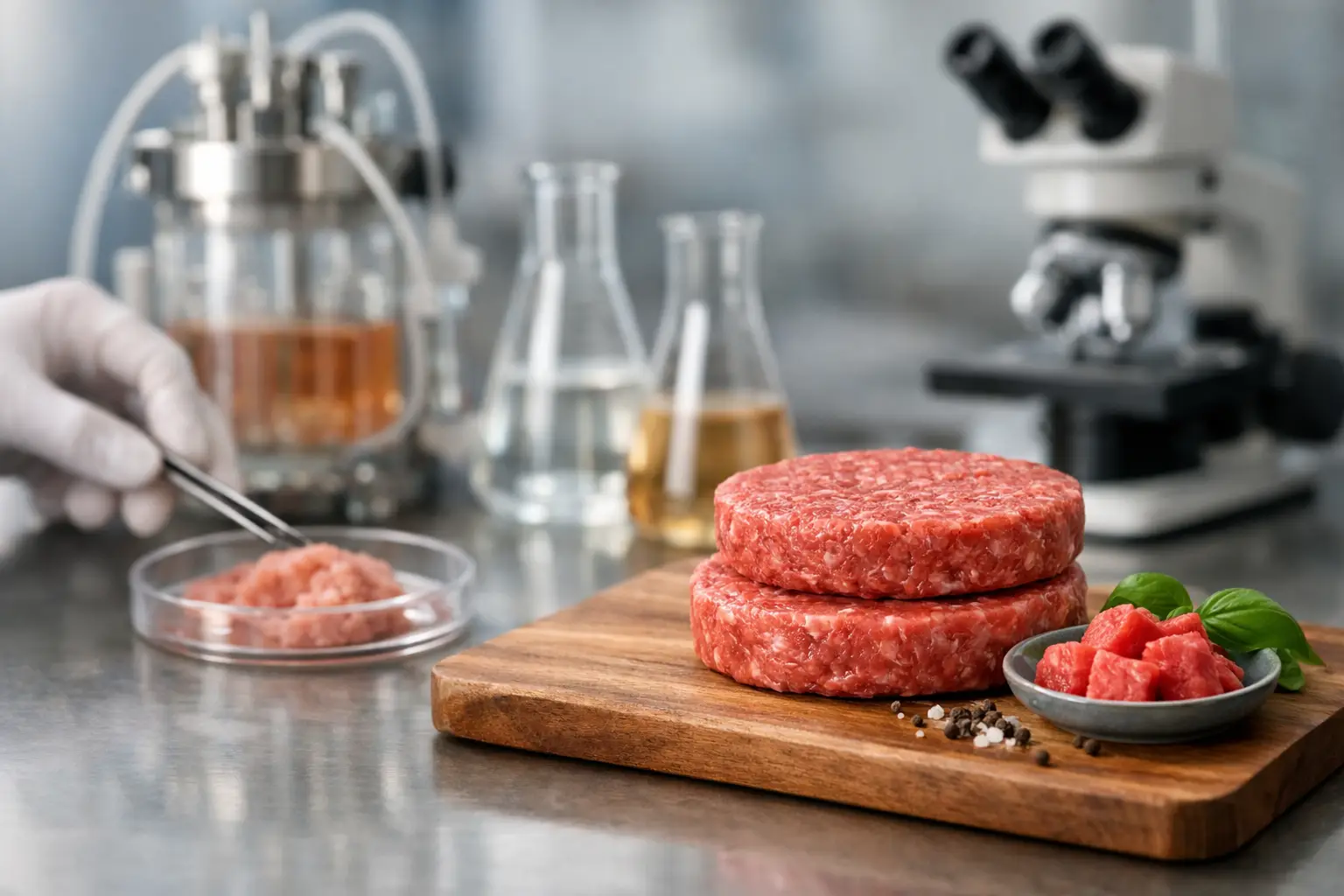
A chicken breast grown from animal cells rather than raised on a farm may sound like the future of food. But for those of us who value real food produced the traditional way, the more important question is not only whether regulators currently allow it, but whether it belongs on our plates at all.
For certain cultivated meat products, U.S. regulators have completed premarket reviews and allowed them to enter the food supply under federal requirements.1.2 But there is an important distinction between “regulators have determined that a particular product can be marketed” and “this is a food we consider healthy, necessary, or preferable.”
At Blissenza, we believe that distinction matters.
We do not believe replacing traditionally raised meat with laboratory-cultivated meat is a necessary step toward better health. When given the choice, we prefer real meat raised traditionally and responsibly, with as little unnecessary processing as possible.
So rather than asking only, “Is it technically safe enough to sell?” we think consumers should also ask:
Why should we replace a traditional food with a highly engineered alternative when we still do not know what decades of regular consumption will mean?
Is Lab Grown Meat Safe in the United States?
In the United States, cultivated meat must go through a regulatory process before it can be sold. The FDA evaluates aspects of the production process before certain products enter the market, including the animal cells, cell lines and cell banks, manufacturing controls, and the materials and inputs used during production.3 For meat and poultry products under USDA jurisdiction, USDA-FSIS oversees the processing, inspection, and labeling stages.4
That oversight is important, but it should not be misunderstood.
The FDA’s premarket consultation is not a blanket declaration that cultivated meat is healthy or that every future cultivated-meat product will be safe simply because another product completed the process. The consultation is conducted on a product-by-product basis.5
And this is where we believe consumers should look beyond the regulatory label.
Regulatory agencies are primarily concerned with whether a product meets established food-safety requirements. They are not declaring that a food represents the best possible choice for long-term nutrition, nor are they telling consumers that it is preferable to traditionally raised meat.
“Allowed on the market” and “best choice for your health” are two very different questions.
It’s also worth noting that this entire conversation is unfolding while states like Montana are actively pushing back, banning the sale of lab-grown meat outright.6 That kind of legislative resistance doesn’t happen over nothing, it reflects real, widely shared discomfort with treating a lab-engineered protein the same as meat that came from an animal raised on land, eating grass or feed, the way meat has been produced for all of human history.
What Is Cultivated Meat Actually Made From?
Despite the popular term “lab grown meat,” cultivated meat is generally produced in highly controlled industrial facilities rather than literally being grown on a laboratory bench.7
Companies begin with animal cells and multiply them in controlled environments called bioreactors. The cells receive carefully formulated nutrients such as amino acids, sugars, vitamins, and minerals needed for growth and development. Eventually, the resulting material is harvested and processed into a food product.8.9
That process is fundamentally different from raising an animal and obtaining meat from it.
And that distinction is important to us at Blissenza.
Traditional meat comes from an animal that has grown naturally, consuming food and developing muscle and fat through normal biological processes. Cultivated meat takes animal cells and places them into an engineered manufacturing system designed to produce meat-like tissue at industrial scale.10
The resulting product may also contain additional ingredients depending on the formulation and the final food being produced.
Calling something “meat” does not automatically make it nutritionally or biologically equivalent to traditionally raised meat.
Its nutritional profile, including protein, fat composition, micronutrients and other characteristics, depends on the specific product, formulation and manufacturing process.11.12
In other words, “cultivated” describes how the product was manufactured—not whether it is a superior food.
The Food Safety Questions Are Still Important
Any new food-production technology deserves serious safety evaluation.
Cultivated-meat production introduces its own set of questions, including the stability of cell lines, contamination during cell culture, substances used during production, potential residues, allergenicity, and nutritional characteristics.13
A scientific review of cultivated-meat production identified several potential hazards requiring consideration, including genetic stability of cell lines, microbiological contamination, exposure to substances used during production, toxicity and allergenicity, chemical residues, post-harvest contamination, and nutritional risks.14 Marketing claims such as “antibiotic-free” should be examined carefully; they do not automatically equal a cleaner or better product overall.
That does not prove cultivated meat is dangerous. But it does demonstrate why “the regulators looked at it” should not end the conversation.
Traditional meat certainly has food safety risks. Bacteria such as Salmonella and Campylobacter can contaminate conventional meat, which is why proper handling, refrigeration and cooking are so important.
But there is a difference between managing known risks associated with a traditional food and introducing an entirely new production system and assuming that its long-term consequences are already understood.
Novelty itself is not proof of danger, but neither is novelty proof of safety.
What We Still Do Not Know
This is perhaps the most important part of the discussion.
The largest limitation is straightforward: We do not yet have decades of population-level evidence showing how frequent consumption of cultivated meat affects human health over the long term.15 That is different from claiming the food has been proven harmful, it means the long-term evidence simply does not yet exist.
A recent review published in The Lancet Planetary Health examined 247 studies comparing alternative animal-source foods with conventional animal products and concluded that the evidence remains fragmented and uneven, with relatively few studies directly comparing nutritional quality and health effects in equivalent substitutions.16
That matters.
A food can pass a regulatory safety assessment without having decades of evidence demonstrating what happens when people consume it regularly throughout their lives. We should not pretend those are the same thing.
There are also unanswered nutritional questions. Producers may eventually be able to engineer cultivated meat with specific nutritional characteristics, but theoretical possibilities are not the same as demonstrated health benefits in humans.17
A futuristic production method is not automatically a nutritional improvement.
Beyond the open science, many of us also have legitimate values based reasons to be cautious: we worry about corporate consolidation of the food system, about how much processing and engineering stands between a “food” and its natural source, and most of all we simply prefer to eat what animals and land have always produced, rather than what a bioreactor produces.
Is More Technology Always Better Food?
This is where the conversation becomes bigger than food safety. Modern food technology can accomplish remarkable things. But the fact that we can manufacture something does not necessarily mean we should make it a regular part of our diet.
Humans have consumed meat from animals for thousands of years, and modern agriculture has developed well-established systems for producing, handling and preparing it. We understand how conventional meat is produced, how it is stored, how it is cooked and how it fits into traditional diets.
Cultivated meat asks consumers to place their trust in a considerably more complex industrial system.
Producers must select and maintain the cells, grow them under controlled conditions, supply nutrients and other inputs, harvest and process the cells, and may then combine the final product with additional ingredients before it reaches the consumer.18.19
That is a very different relationship with food.
At Blissenza, we believe simpler is generally better when it comes to everyday nutrition.
That does not mean every traditional food is automatically healthy, nor that every modern technology is bad. It means we see no compelling reason to replace a familiar, minimally processed food with a highly engineered alternative when the long-term health evidence for that alternative is still developing.
Environmental Claims Deserve the Same Scrutiny
Companies and advocates often promote cultivated meat as a solution to the environmental problems associated with livestock production.20
Some potential advantages are plausible. Cultivated meat could reduce the need for land associated with raising animals and eliminate the slaughter of animals for the production of the cultivated tissue.
But environmental claims should not automatically translate into health claims.
Large-scale cultivated-meat production requires specialized facilities, bioreactors, energy, nutrients, equipment and other inputs. The environmental footprint of cultivated meat depends heavily on how efficiently producers can make it and which energy sources power the manufacturing process.
In other words:
“Potentially more sustainable” does not mean “proven healthier.”
Those are separate questions, and we should evaluate them separately.
What About the Nutritional Value?
This is another area where consumers should be careful with marketing.
A cultivated-meat producer could theoretically formulate a product to contain desirable amounts of protein, vitamins, minerals, or particular types of fat. But the ability to engineer those characteristics does not automatically make the resulting product nutritionally superior.
A recent scientific review found mixed nutritional profiles among alternative animal-source foods, and researchers still have limited evidence directly comparing their health effects with those of conventional animal products.21
The complete ingredient list still matters.
Who May Want to Be More Cautious?
Anyone with a serious food allergy, a medically restricted diet, or a history of unexplained reactions to meat products should examine the ingredient list carefully and discuss concerns with a qualified healthcare professional.
Parents may also reasonably decide that they would rather give their children familiar, minimally processed sources of protein while more research accumulates.
And for people who are pregnant, immunocompromised, managing chronic disease or dealing with nutritional deficiencies, there is even less reason to experiment unnecessarily with a new food technology when established alternatives are readily available.
This doesn’t mean that cultivated meat has proven dangerous for these groups. It’s because the evidence base is still developing, and there is no nutritional requirement to eat cultivated meat.
You can obtain protein and other important nutrients from real foods with a much longer history of human consumption: traditionally raised meat, poultry, fish, eggs, dairy, beans, lentils and other minimally processed foods remain excellent options.
What We Would Choose at the Store
If cultivated meat becomes available where you live, you do not have to buy it simply because it’s new, technologically impressive, or marketed as the future of food.
Read the label, examine the ingredients, and compare the product’s nutritional profile with that of the traditional food it aims to replace. Consumers may find that the conventional option offers a more familiar and established nutritional profile, not because cultivated meat automatically fails a safety test, but because its long-term nutritional advantages remain unproven, and then ask a more fundamental question:
Do I actually need this?
At Blissenza, our answer is a BIG NO.
- If we want chicken, we would rather eat traditionally raised chicken.
- If we want beef, we would rather choose beef from a responsible source.
- If we want fish, we would rather eat actual fish.
We prefer foods that remain recognizable as the foods our families have eaten for generations.
That does not mean we believe conventional meat production is perfect. Responsible farming, animal welfare, sustainable agriculture, proper handling and good sourcing all matter.
But we believe the answer to improving the food system should not automatically be to make food more technologically complex.
Sometimes the better answer is to return to what already works.
Why Consumer Choice Matters
For us, this is not simply a question of whether government should tell people what they can eat.
It is also a question of what kind of food system we want to build.
Do we want a food supply increasingly dependent on sophisticated industrial facilities, proprietary technologies, specialized inputs and companies capable of manufacturing animal tissue? or do we want to continue supporting farmers, ranchers, fisheries, traditional agriculture and food systems that keep our connection between land, animals, farmers, and consumers intact?
At Blissenza, we strongly favor the latter.
The Bottom Line: Safe Enough to Sell Does Not Mean Better to Eat
So, is lab-grown meat safe?
For specific products that have completed the applicable U.S. regulatory process, regulators have determined that the available information does not prevent those products from entering the market under federal requirements. But that is a much narrower conclusion than saying cultivated meat has been proven healthy for long-term human consumption.
And that distinction is exactly why we believe consumers should slow down before embracing this technology as the “future of meat.”
There is still limited long-term human evidence, there are unanswered nutritional questions, the production process is highly engineered, and there is no nutritional necessity for anyone to consume cultivated meat.
At Blissenza, we support restrictions and bans on lab grown meat. We believe the best way to consume meat is the traditional way—from animals raised for food—rather than cells multiplied in industrial bioreactors. We strongly support responsible farmers and ranchers producing real meat.
When it comes to food, our preference is simple: Give us the real thing.
- Raised traditionally.
- Prepared simply.
Because sometimes, the old-fashioned way isn’t something we need to replace, it’s something worth preserving.
Sources:
- FDA – Human Food Made with Cultured Animal Cells – https://www.fda.gov/food/food-ingredients-packaging/human-food-made-cultured-animal-cells
- FDA – Inventory of Completed Pre-market Consultations for Human Food Made with Cultured Animal Cells – https://www.fda.gov/food/human-food-made-cultured-animal-cells/inventory-completed-pre-market-consultations-human-food-made-cultured-animal-cells
- FDA – FDA Completes First Pre-Market Consultation for Human Food Made Using Animal Cell Culture Technology – https://www.fda.gov/food/hfp-constituent-updates/fda-completes-first-pre-market-consultation-human-food-made-using-animal-cell-culture-technology
- FDA – https://www.fda.gov/food/human-food-made-cultured-animal-cells/formal-agreement-between-fda-and-usda-regarding-oversight-human-food-produced-using-animal-cell – Formal Agreement Between FDA and USDA Regarding Oversight of Human Food Produced Using Animal Cell Technology Derived from Cell Lines of USDA-amenable Species
- FDA – FDA Completes Second Pre-Market Consultation for Human Food Made Using Animal Cell Culture Technology – https://www.fda.gov/food/hfp-constituent-updates/fda-completes-second-pre-market-consultation-human-food-made-using-animal-cell-culture-technology
- HHS – Montana HB 401: Ban on Lab-Grown Meat Sales – https://docs.legmt.gov/download-ticket?ticketId=7772bd3c-6741-49a7-887b-502c07b4d98a
- FDA – Human Food Made with Cultured Animal Cells – https://www.fda.gov/food/food-ingredients-packaging/human-food-made-cultured-animal-cells
- FDA – Human Food Made with Cultured Animal Cells – https://www.fda.gov/food/food-ingredients-packaging/human-food-made-cultured-animal-cells
- Che Julius Ngwa, Kuo-Hui Chiu, Katharina J Brenner, Carlos Rodrigues, Zdenka Peršin, Jernej Vajda, Boštjan Vihar, Jordi Morales-Dalmau, Frederico Castelo Ferreira, Marius Henkel, Stefan Schillberg. Bioreactor parameters and systems for cultured meat production, Future Foods. Volume 12, 2025, 100796, ISSN 2666-8335, https://doi.org/10.1016/j.fufo.2025.100796.
- FDA – Human Food Made with Cultured Animal Cells – https://www.fda.gov/food/food-ingredients-packaging/human-food-made-cultured-animal-cells
- Beal T, McLaren R, Saxena T, Sokourenko K, Nordhagen S, Lambertini E, DiGiovine E, Xipsiti M, Neufeld LM. Nutritional and health impacts of alternative animal source foods: a scoping review. Lancet Planet Health. 2026 Feb;10(2):101423. doi: 10.1016/j.lanplh.2025.101423. Epub 2026 Feb 9. Erratum in: Lancet Planet Health. 2026 Jun;10(6):101496. doi: 10.1016/j.lanplh.2026.101496. PMID: 41679326.
- Annual Reviews – Technological Advances and the Challenges for Large-Scale Cultured Meat Production – https://www.annualreviews.org/content/journals/10.1146/annurev-food-053124-085815
- Zandonadi RP, Ramos MC, Elias FTS, Guimarães NS. Global Insights into Cultured Meat: Uncovering Production Processes, Potential Hazards, Regulatory Frameworks, and Key Challenges-A Scoping Review. Foods. 2025 Jan 4;14(1):129. doi: 10.3390/foods14010129. PMID: 39796419; PMCID: PMC11720233.
- Zandonadi RP, Ramos MC, Elias FTS, Guimarães NS. Global Insights into Cultured Meat: Uncovering Production Processes, Potential Hazards, Regulatory Frameworks, and Key Challenges-A Scoping Review. Foods. 2025 Jan 4;14(1):129. doi: 10.3390/foods14010129. PMID: 39796419; PMCID: PMC11720233.
- D. Mafra, L. Trugilho, F. Nerbass, P. Stenvinkel, and L. F. M. F. Cardozo, “ Could Cultured Meat Be a Sustainable and Safe Source of Protein?.” Molecular Nutrition & Food Research 69, no. 24 (2025): e70319. https://doi.org/10.1002/mnfr.70319
- Beal T, McLaren R, Saxena T et al. Nutritional and health impacts of alternative animal source foods: a scoping review The Lancet Planetary Health, 2026; 10
- Kardas, M., W. Staśkiewicz-Bartecka, and A. Kołodziejczyk. 2025. “ Cultured Meat Reformulation: Health Potential and Sustainable Food Challenges—Narrative Review.” Comprehensive Reviews in Food Science and Food Safety 24, no. 6: e70262. https://doi.org/10.1111/1541-4337.70262
- FDA – Human Food Made with Cultured Animal Cells – https://www.fda.gov/food/food-ingredients-packaging/human-food-made-cultured-animal-cells
- Yunting Xie, Shijie Ding, Jie Wang, Xiufeng Li, Renpeng Guo, et al. 2026. Technological Advances and the Challenges for Large-Scale Cultured Meat Production. Annual Review of Food Science and Technology 17:417-438. https://doi.org/10.1146/annurev-food-053124-085815
- Francesca Orsini, Laura Pierini, Ilaria Ardoino, Carlotta Franchi; Environmental Impact of Cultured Meat: A Systematic Review. ACS Food Sci. Technol. 20 February 2026; 6 (2): 227–239. https://doi.org/10.1021/acsfoodscitech.5c00908
- Beal T, McLaren R, Saxena T et al. Nutritional and health impacts of alternative animal source foods: a scoping review The Lancet Planetary Health, 2026; 10