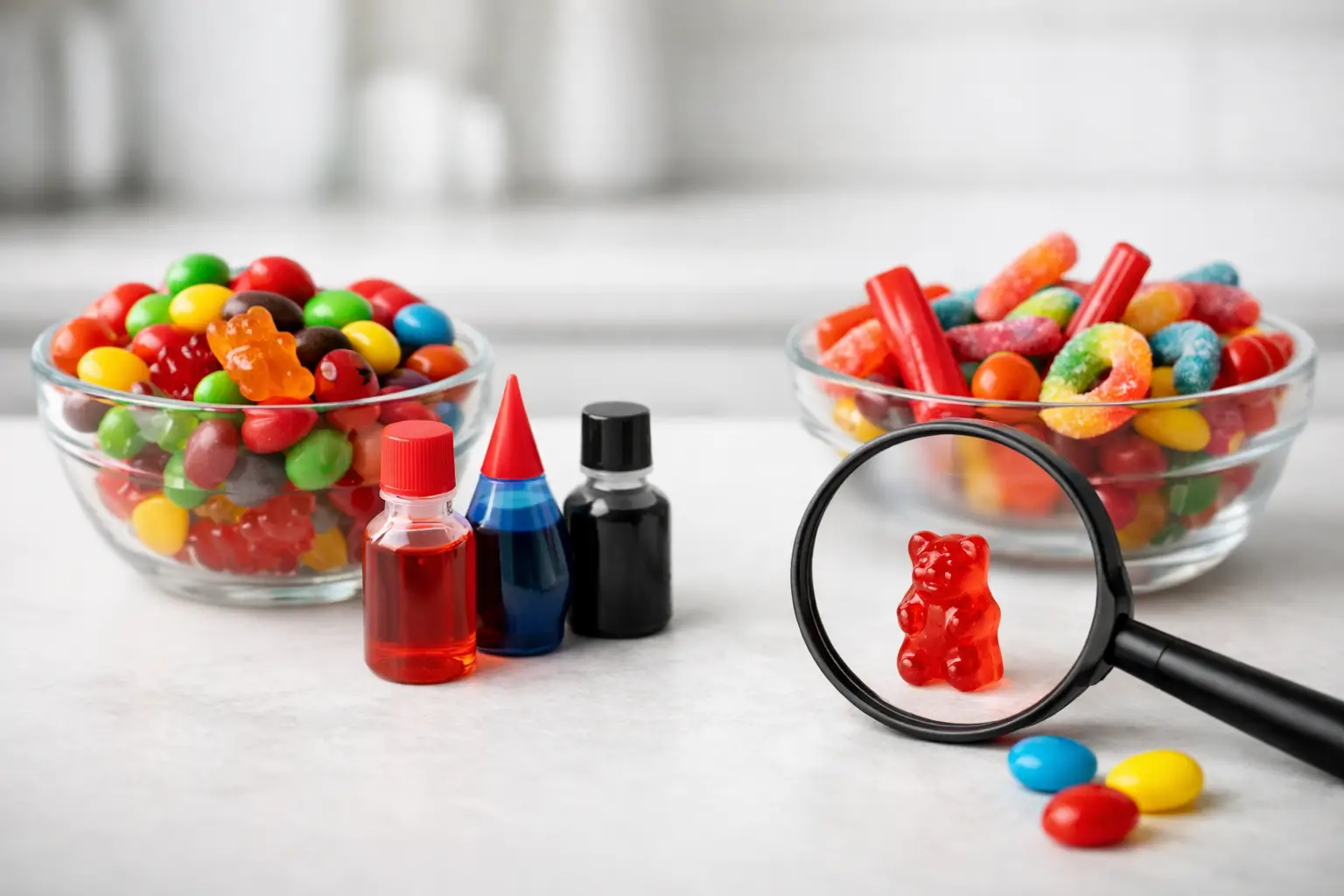
A neon-blue sports drink, bright orange cheese crackers, and a birthday cupcake with electric pink frosting may look like harmless fun. But when you stop and ask why a food needs to be that intensely colored in the first place, a more important question emerges: are artificial food dyes harmful?
For years, consumers have been told that approved food dyes are safe when consumed within established limits. But “approved” should not be confused with “healthy” and it certainly should not be confused with “necessary.”
Artificial food dyes provide no nutritional benefit, their primary purpose is to make processed foods look brighter, more appealing, and more marketable.1 At the same time, a growing body of research has raised concerns about their effects on children’s behavior and other potential health effects. California’s Office of Environmental Health Hazard Assessment (OEHHA), after reviewing toxicology, epidemiological, clinical, and exposure research, concluded that synthetic food dyes can contribute to adverse neurobehavioral effects in some children, including hyperactivity, inattention, and restlessness.2·3·4
And the concern is no longer coming only from researchers or health advocates. In 2025, the U.S. FDA announced a national initiative to move away from petroleum-based synthetic food dyes, specifically targeting dyes including Red No. 40, Yellow No. 5, Yellow No. 6, Blue No. 1, Blue No. 2, and Green No. 3.5
For us at Blissenza, the practical takeaway is simple: if a synthetic color provides no nutritional benefit and credible evidence raises concerns about potential neurobehavioral effects in some children, we see little reason to make these additives part of a healthy everyday diet.
What Are Artificial Food Dyes?
Artificial food dyes are synthetic color additives used to make foods and beverages look brighter, more uniform or more visually appealing. In the United States, you may see them on an ingredient label as names such as FD&C Red No. 40, Yellow No. 5, Yellow No. 6, Blue No. 1, Blue No. 2, or Green No. 3.
They are common in products where appearance is part of the selling strategy: candy, frosting, cereal, fruit snacks, soda, sports drinks, flavored yogurt, boxed baking mixes, and packaged desserts.
A strawberry-flavored snack does not need to be bright red to taste sweet, a sports drink does not need to glow blue to hydrate you, a cereal does not need neon colors to provide breakfast.
The color is there to influence appearance—and often, our expectations about the food.6
That would be less concerning if these dyes were nutritionally meaningful, they are not.
The bigger issue is that synthetic dyes are overwhelmingly associated with highly processed foods. So eliminating them can have a double benefit: you reduce exposure to synthetic color additives while also replacing some of the candy, sugary drinks, brightly colored cereals, and ultra-processed snacks in your diet with more nourishing foods.
Are Artificial Food Dyes Harmful to Health?
This is where the conversation needs more nuance than simply saying, “The FDA approved them, so they’re safe.”
Regulatory approval means that an agency has determined that a substance can be used under specified conditions. It does not mean the substance is beneficial, essential or equally appropriate for every person.
And the science is not as reassuring as the front of a brightly colored package might suggest.
One of the strongest areas of concern is children’s behavior. A landmark randomized, double-blind, placebo-controlled study published in The Lancet found an association between consumption of mixtures containing artificial food colors and increased hyperactive behavior in children.7
The evidence has continued to receive attention. California’s OEHHA conducted an extensive review of human and animal research and concluded that synthetic food dyes are associated with adverse neurobehavioral effects in sensitive children, including inattention, hyperactivity, and restlessness.8 The report also concluded that some children are likely to be more adversely affected than others.
Importantly, this does not mean that food dyes cause ADHD in every child. It means that susceptibility appears to vary, and there is enough evidence to take the potential behavioral effects seriously rather than dismissing them as a myth.
The European Food Safety Authority also found that the Southampton research provided limited evidence of a small effect on the activity and attention of some children, although the effects were not consistent across all age groups and mixtures tested.9
For parents, that distinction matters. You do not need to prove that a dye is responsible for every difficult afternoon before deciding that you would rather avoid unnecessary synthetic colorants in your child’s diet.
Red 40 Deserves Special Attention
Red No. 40 is one of the most widely used synthetic food dyes in the United States. It appears in countless candies, beverages, cereals, desserts and children’s foods.
It is also one of the dyes included in California’s extensive review of synthetic food dyes and in the FDA’s current national effort to move away from petroleum-based synthetic colors.
That does not mean we can honestly say that Red 40 causes a specific disease in every person who consumes it. The evidence does not support such a sweeping claim, but it does mean there is little reason to deliberately seek it out.
Red 40 provides no nutritional benefit, is not necessary to make the food, and belongs to a category of synthetic dyes for which credible concerns about children’s neurobehavioral health have been raised.10·11
When a naturally colored or dye-free alternative is readily available, choosing it is a simple decision.
What About Red No. 3 and Cancer?
Red No. 3 provides another important lesson about why “approved” does not necessarily mean “something we should keep consuming indefinitely.”
In January 2025, the FDA revoked authorization for FD&C Red No. 3 in food and ingested drugs under the Delaney Clause after data showed that high exposure caused cancer in male laboratory rats.12 The FDA also emphasized that the specific hormonal mechanism involved does not occur in humans and that available evidence does not demonstrate that Red No. 3 causes cancer in people. Manufacturers have until January 15, 2027, to reformulate foods containing the dye.13·14
But there is another lesson worth considering: a synthetic dye can remain legally permitted for decades and later lose its authorization when regulatory standards and scientific evidence change.
In other words, waiting for every questionable additive to be formally banned is not the only reasonable approach. Consumers can choose to avoid unnecessary synthetic dyes before regulators require manufacturers to remove them.
Allergies and Sensitivities Are Possible
True allergic reactions to food dyes appear to be uncommon, but sensitivity reactions can occur.
Yellow No. 5, also known as tartrazine, has been associated with hypersensitivity reactions in some susceptible individuals. Reactions can include hives, eczema, asthma, angioedema and hyperactive behavior.15 If you notice a repeatable reaction after consuming a brightly colored product, it is worth paying attention rather than automatically assuming it is unrelated.
At the same time, a reaction after colorful food does not automatically prove that the dye is responsible. Other ingredients, preservatives, flavorings, or the food itself may be involved.
If you experience facial swelling, trouble breathing, widespread hives, or severe symptoms, seek urgent medical attention.
For recurring milder reactions, keep track of the products involved and discuss the pattern with a qualified health professional.
Why Artificial Dyes Are Particularly Problematic in Children’s Foods
Look at the foods most heavily marketed to children and you will often find the same combination: bright colors, intense sweetness, refined carbohydrates, and highly processed ingredients.
Color helps turn ordinary food into an experience.
That is why artificial dyes are especially difficult to separate from the broader problem of ultra-processed children’s foods. A brightly colored cereal, candy, sports drink, fruit snack, or packaged dessert may contain several ingredients that are less than ideal—not just the dye.
This is one reason eliminating synthetic dyes can be such a useful household rule.
Instead of trying to determine whether your child reacts to Red 40 but not Yellow 6, or whether Blue 1 is worse than Yellow 5, you can simply establish a simpler standard:
Whenever possible, choose foods without synthetic dyes.
That does not require perfection. It simply removes an unnecessary class of additives from the foods your family eats most often.
Who May Benefit Most From Cutting Back?
A lower-dye or dye-free approach can be especially useful for families who notice a repeatable connection between certain foods and a child’s behavior.
The useful word is repeatable.
One energetic afternoon after cake and soda does not prove much. But if similar changes in attention, restlessness, irritability, or behavior repeatedly appear after brightly colored cereals, candies, drinks, or snacks, that pattern deserves attention.
OEHHA’s review specifically concluded that children vary in their sensitivity to synthetic food dyes, which helps explain why one child may appear unaffected while another reacts noticeably.
Adults can benefit from eliminating dyes for a different—and often simpler—reason: it can help reduce reliance on ultra-processed foods.
If you are working on steadier energy and appetite, better digestion, or healthier eating habits, replacing brightly colored snack foods with fruit, nuts, yogurt, eggs, vegetables, or other minimally processed choices can move your diet in a better direction.
The dye may not be the only problem.
But it is a useful warning sign.
A Practical Way to Eliminate Artificial Food Dyes
You do not need to throw away everything in your pantry overnight.
Start with the foods your family eats most frequently. Check the ingredient lists on cereals, drinks, candy, snacks, desserts, yogurt products, and children’s foods.
Look specifically for:
- Red 40 / FD&C Red No. 40
- Red 3 / FD&C Red No. 3
- Yellow 5 / FD&C Yellow No. 5
- Yellow 6 / FD&C Yellow No. 6
- Blue 1 / FD&C Blue No. 1
- Blue 2 / FD&C Blue No. 2
- Green 3 / FD&C Green No. 3
- “Artificial colors”
- “Artificial color added”
- “Lake” forms of synthetic dyes
Then replace the products you consume most often.
Choose plain or lightly sweetened yogurt with real berries instead of brightly colored yogurt tubes. Try fruit, nuts, cheese, hummus, popcorn with simple ingredients, or roasted chickpeas instead of neon-colored snack foods. Choose cereals without synthetic dyes. Look for drinks that get their color from recognizable sources—or simply do not need added color at all.
For celebrations or special occasions, you can still enjoy dessert. But if a naturally colored frosting or dye-free option is available, there is no reason to assume the artificial version is the healthier choice.
What About “Natural” Food Coloring?
Not every food colored with a plant-derived ingredient is automatically healthy. A fruit snack colored with beet juice is still a fruit snack. A sugary cereal colored with spirulina is still a sugary cereal.
The goal is not to turn one ingredient into a magic health filter.
The difference is that natural colors can provide an alternative to synthetic petroleum-based dyes when color is actually desired. The FDA itself is now encouraging the transition toward naturally derived alternatives and has taken steps to make “no artificial colors” labeling easier for manufacturers.16
The most nutritious option, however, is often the simplest one: food that does not need intense artificial coloring in the first place.
The Bigger Picture: Artificial Dyes Have No Place in a Healthy Everyday Diet
Health is shaped by patterns, not a single cupcake.
We are not suggesting that one brightly colored birthday cake will determine your health or your child’s future.
But there is a meaningful difference between occasionally encountering an artificial dye and deliberately building a daily diet around products that contain them.
Synthetic food dyes provide no nutritional value, they are added primarily for appearance. At the same time, credible research has identified potential neurobehavioral effects in some children, and regulators in the United States are now taking steps to reduce the presence of several petroleum-based synthetic dyes in the food supply.
That is enough for us to take a clear position:
You do not need artificial food dyes to eat well. You do not need them to make food more nutritious, so the next time you see a food glowing neon blue, electric red, or unnaturally bright yellow, turn the package around, read the ingredients and ask yourself a very simple question:
Why am I choosing a synthetic chemical to make this food look more appealing when I could simply choose a food that does not need it?
For a healthier everyday diet, our answer is simple: skip the artificial dyes whenever you can.
Sources:
- FDA – Tracking Food Industry Pledges to Remove Petroleum Based Food Dyes – https://www.fda.gov/food/color-additives-information-consumers/tracking-food-industry-pledges-remove-petroleum-based-food-dyes
- OEHHA – Report Links Synthetic Food Dyes to Hyperactivity and other Neurobehavioral Effects in Children – https://oehha.ca.gov/risk-assessment/press-release/report-links-synthetic-food-dyes-hyperactivity-and-other-neurobehavioral-effects-children
- OEHHA – Health Effects Assessment: Potential Neurobehavioral Effects of Synthetic Food Dyes in Children – https://oehha.ca.gov/risk-assessment/report/health-effects-assessment-potential-neurobehavioral-effects-synthetic-food-dyes-children
- Miller, M.D., Steinmaus, C., Golub, M.S. et al. Potential impacts of synthetic food dyes on activity and attention in children: a review of the human and animal evidence. Environ Health 21, 45 (2022). https://doi.org/10.1186/s12940-022-00849-9
- FDA – HHS, FDA to Phase Out Petroleum-Based Synthetic Dyes in Nation’s Food Supply – https://www.fda.gov/news-events/press-announcements/hhs-fda-phase-out-petroleum-based-synthetic-dyes-nations-food-supply
- FDA – Color Additives Questions and Answers for Consumers – https://www.fda.gov/food/color-additives-information-consumers/color-additives-questions-and-answers-consumers
- McCann D, Barrett A, Cooper A, Crumpler D, Dalen L, Grimshaw K, Kitchin E, Lok K, Porteous L, Prince E, Sonuga-Barke E, Warner JO, Stevenson J. Food additives and hyperactive behaviour in 3-year-old and 8/9-year-old children in the community: a randomised, double-blinded, placebo-controlled trial. Lancet. 2007 Nov 3;370(9598):1560-7. doi: 10.1016/S0140-6736(07)61306-3. Erratum in: Lancet. 2007 Nov 3;370(9598):1542. PMID: 17825405.
- OEHHA – Report Links Synthetic Food Dyes to Hyperactivity and other Neurobehavioral Effects in Children – https://oehha.ca.gov/risk-assessment/press-release/report-links-synthetic-food-dyes-hyperactivity-and-other-neurobehavioral-effects-children
- EFSA – EFSA evaluates Southampton study on food additives and child behaviour – https://www.efsa.europa.eu/en/news/efsa-evaluates-southampton-study-food-additives-and-child-behaviour
- FDA – Tracking Food Industry Pledges to Remove Petroleum Based Food Dyes – https://www.fda.gov/food/color-additives-information-consumers/tracking-food-industry-pledges-remove-petroleum-based-food-dyes
- OEHHA – Synthetic Food Dye Risk Assessment – https://oehha.ca.gov/risk-assessment/synthetic-food-dye-risk-assessment
- FDA – FDA to Revoke Authorization for the Use of Red No. 3 in Food and Ingested Drugs – https://www.fda.gov/food/hfp-constituent-updates/fda-revoke-authorization-use-red-no-3-food-and-ingested-drugs
- FDA – FDA to Revoke Authorization for the Use of Red No. 3 in Food and Ingested Drugs – https://www.fda.gov/food/hfp-constituent-updates/fda-revoke-authorization-use-red-no-3-food-and-ingested-drugs
- Federal Register – Color Additive Petition From Center for Science in the Public Interest, et al.; Request To Revoke Color Additive Listing for Use of FD&C Red No. 3 in Food and Ingested Drugs – https://www.federalregister.gov/documents/2025/01/16/2025-00830/color-additive-petition-from-center-for-science-in-the-public-interest-et-al-request-to-revoke-color
- Drugs.com – FD&C Yellow No. 5 – https://www.drugs.com/inactive/fd-c-yellow-no-5-250.html
- FDA – HHS, FDA to Phase Out Petroleum-Based Synthetic Dyes in Nation’s Food Supply – https://www.fda.gov/news-events/press-announcements/hhs-fda-phase-out-petroleum-based-synthetic-dyes-nations-food-supply