
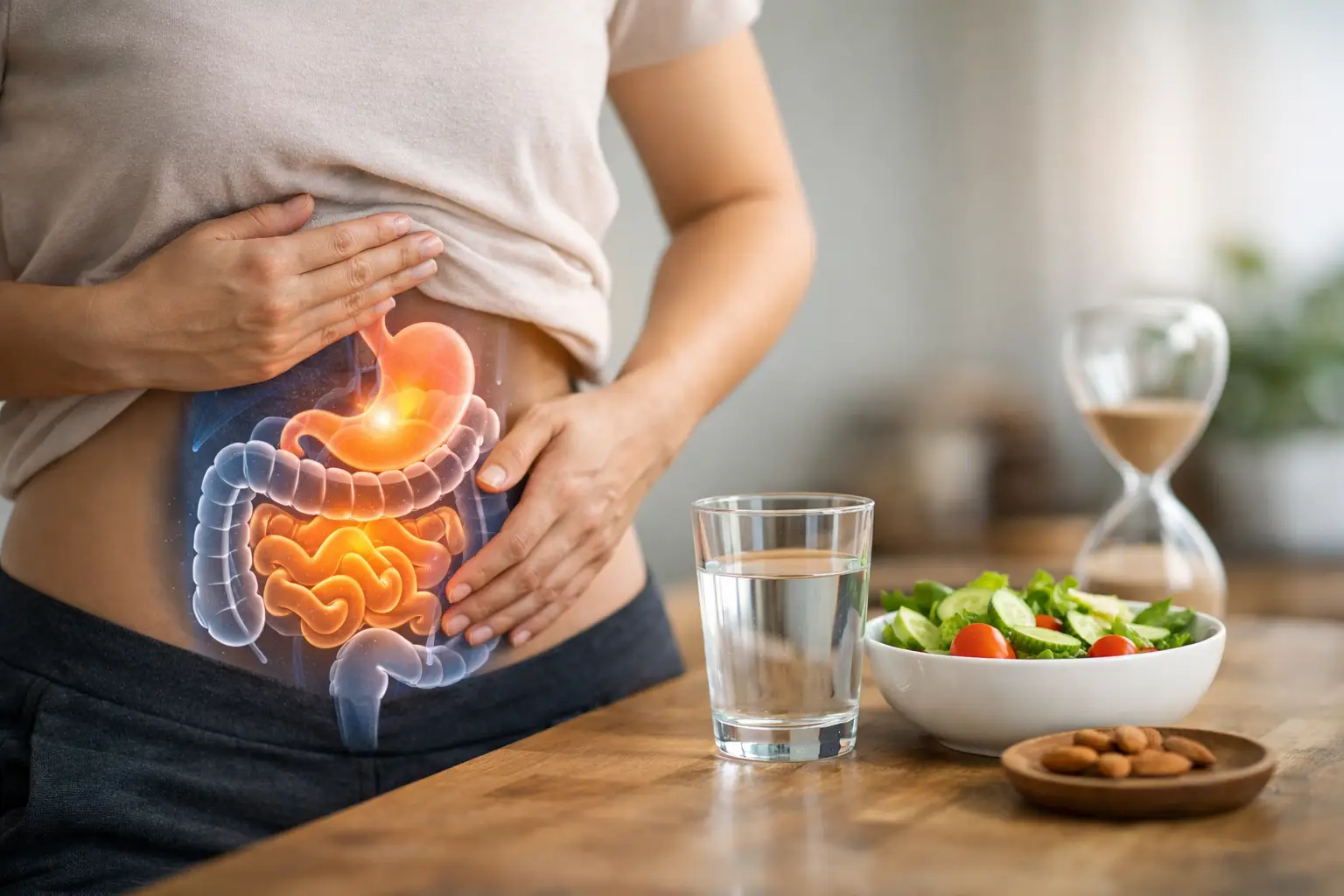
That light, settled feeling some people get after skipping breakfast can be real. So can the headache, heartburn, constipation, or intense urge to overeat that others experience by lunchtime. How does fasting affect digestion? It depends on your fasting schedule, what you eat when you do eat, your usual gut health, medications, stress level, and whether your body is getting enough food overall.
Fasting is not a digestive reset button, and it is not automatically harmful either. A well-planned overnight fast or time-restricted eating schedule may give some people a more comfortable rhythm around meals. But longer, more restrictive fasts can create digestive problems, especially when they lead to dehydration, low fiber intake, or rebound eating.1
How fasting affects digestion in the short term
Digestion does not fully switch off when you stop eating. Your stomach continues making acid, your intestines keep moving, and your gut microbes continue working with the material already present in your digestive tract. What changes is the workload.2
After a meal, your body directs energy toward breaking down food, absorbing nutrients, and moving waste through the colon. During a fasting period, the digestive system has less new food to process. Between meals, the small intestine also uses a pattern of sweeping contractions called the migrating motor complex. Think of it as routine housekeeping that helps move leftover particles and bacteria along.3
For some people, this break from frequent snacking can mean less bloating, less post-meal heaviness, and fewer reflux symptoms. If late-night eating is a regular habit, simply finishing dinner earlier may reduce the pressure and discomfort that can make lying down unpleasant.
Still, an empty stomach can feel uncomfortable. Hunger-related stomach growling is normal, but fasting may also bring nausea, acid reflux, or a burning sensation for people prone to gastritis or reflux. Coffee, energy drinks, alcohol and spicy foods can worsen symptoms in some people, particularly those prone to reflux.4
Your gut microbiome may respond to meal timing
Your gut microbiome is the community of microbes that helps digest certain fibers and produces compounds that support the intestinal lining. These microbes respond not only to what you eat, but also to when you eat.5
Early research suggests that consistent eating and fasting windows may support daily rhythms in the gut. In practical terms, avoiding all-day grazing and giving yourself a predictable overnight break may be helpful for some people. But fasting does not replace the foods your gut microbes need most: adequate fluids and a varied diet.
Why bowel habits can change
Constipation is one of the most common digestive complaints during fasting. Less food entering the digestive tract may mean less stool volume. If you also drink less water or cut out high-fiber foods, stools may become harder and less frequent.
The opposite can happen when a fast ends with a very large meal. Suddenly eating a lot of fat, sugar, caffeine, or highly processed food can speed up intestinal movement and trigger cramping or loose stools. This is one reason a fast is best broken with a balanced meal rather than a reward-style feast.6
Can fasting help bloating, reflux, or IBS?
Sometimes, but the answer is personal. Bloating often improves when someone stops constant snacking, cuts back on carbonated drinks, or identifies a food that was bothering them. Fasting may get the credit when the real improvement came from those related changes.7
For reflux, an earlier dinner and a two- to three-hour gap before lying down can be more useful than a long daytime fast.8 Some people find that skipping breakfast makes reflux worse because stomach acid and coffee hit an empty stomach. Others feel better with a later first meal. Your symptoms are the better guide than a popular fasting schedule.
Irritable bowel syndrome is even more individual. Different dietary approaches can help different people with IBS, and some people may find that changes in meal timing affect their symptoms. If you have IBS, chronic digestive symptoms, or unexplained weight changes, aggressive fasting is not the place to start.9
The biggest digestion mistake: breaking a fast too fast
A fasting plan can look healthy on paper but backfire at the first meal.10 Going from many hours without food to a huge burger, sugary pastry, or oversized takeout meal can leave you sleepy, bloated, and uncomfortable. It may also make it hard to tell whether fasting itself suits you.
Start with a normal-sized meal that combines protein, fiber, and satisfying fat. For example, eggs with sautéed vegetables and whole-grain toast, Greek yogurt with berries and chia seeds, or salmon with beans and roasted vegetables can ease you back into eating without overwhelming your stomach.
Eat slowly, especially if you are very hungry. Fullness signals take time to reach your brain, and a rushed meal after a fast can turn into accidental overeating.11 If your goal is steadier energy, a balanced first meal usually works better than starting with sweets or refined carbohydrates alone.
A gentler way to try fasting for digestive comfort
For most healthy adults who want to experiment, a modest overnight fast is a sensible starting point. Rather than jumping into 18 or 24 hours without food, try creating a consistent 12-hour window between dinner and breakfast.12 13 If dinner ends at 7 p.m., breakfast at 7 a.m. keeps the approach simple and gives your body routine.
Pay attention to your digestion for two weeks. Notice reflux, bloating, stool frequency, energy, mood, sleep, and how hungry you feel at meals. If you feel well, you might extend the overnight break slightly. There is no prize for pushing the window longer if your body is telling you it is too much.
A few habits make the experiment easier:
- Drink water regularly throughout the day. Herbal tea and plain sparkling water can also fit, but carbonation may worsen bloating for some people.
- Keep meals nutrient-dense enough to meet your needs. Include protein, colorful produce, high-fiber carbohydrates, and healthy fats.
- Limit large late-night meals, particularly if reflux or poor sleep is part of the problem.
- Be cautious with coffee on an empty stomach if it causes jitters, nausea or heartburn.
- Do not use fasting to compensate for overeating or as a way to ignore persistent digestive symptoms.
When fasting may not be a good fit
Fasting is not appropriate for everyone. Children and teens, people who are pregnant or breastfeeding, and anyone with a current or past eating disorder should avoid fasting without individualized guidance from a qualified clinician. People with diabetes, kidney or liver disease, a history of low blood sugar, or other significant medical conditions should get medical advice before changing meal timing.14
Medication timing matters too. Some prescriptions must be taken with food, and skipping meals can raise the risk of low blood sugar for people using insulin or certain diabetes medications. Adults over 50 who are managing fatigue, muscle loss, or unintentional weight loss should be especially careful not to let fasting reduce protein and calorie intake below what their body needs.
Seek medical care for severe abdominal pain, vomiting, black or bloody stools, trouble swallowing, persistent diarrhea, or constipation that does not improve. Those symptoms deserve more than a fasting adjustment.
Your digestion responds best to consistency, not extremes. If fasting leaves you clear-headed, comfortably hungry before meals, and able to eat balanced food without digestive distress, a simple overnight routine may fit your life. If it leaves you fixated on food, exhausted, constipated, or ravenous at night, choosing regular nourishing meals is not a failure – it is useful information from your body.
Sources:
- Mayo Clinic – Intermittent fasting: What are the benefits? – https://www.mayoclinic.org/healthy-lifestyle/nutrition-and-healthy-eating/expert-answers/intermittent-fasting/faq-20441303
- Deloose E, Janssen P, Depoortere I, Tack J. The migrating motor complex: control mechanisms and its role in health and disease. Nat Rev Gastroenterol Hepatol. 2012 Mar 27;9(5):271-85. doi: 10.1038/nrgastro.2012.57. PMID: 22450306.
- Telford GL, Sarna SK. The migrating myoelectric complex of the small intestine. Chaos. 1991 Oct;1(3):299-302. doi: 10.1063/1.165843. PMID: 12779928.
- National Institute of Diabetes and Digestive and Kidney Diseases – Eating, Diet, & Nutrition for GER & GERD – https://www.niddk.nih.gov/health-information/digestive-diseases/acid-reflux-ger-gerd-adults/eating-diet-nutrition
- National Institute of Diabetes and Digestive and Kidney Diseases – Food Portions: Choosing Just Enough for You – https://www.niddk.nih.gov/health-information/weight-management/just-enough-food-portions
- Semnani-Azad Z, Khan T A, Chiavaroli L, Chen V, Bhatt H A, Chen A et al. Intermittent fasting strategies and their effects on body weight and other cardiometabolic risk factors: systematic review and network meta-analysis of randomised clinical trials BMJ 2025; 389 :e082007 doi:10.1136/bmj-2024-082007
- Jiang Y, Sonu I, Garcia P, Fernandez-Becker NQ, Kamal AN, Zikos TA, Singh S, Neshatian L, Triadafilopoulos G, Goodman SN, Clarke JO. The Impact of Intermittent Fasting on Patients With Suspected Gastroesophageal Reflux Disease. J Clin Gastroenterol. 2023 Nov-Dec 01;57(10):1001-1006. doi: 10.1097/MCG.0000000000001788. Epub 2022 Nov 1. PMID: 36730832.
- Jiang Y, Sonu I, Garcia P, Fernandez-Becker NQ, Kamal AN, Zikos TA, Singh S, Neshatian L, Triadafilopoulos G, Goodman SN, Clarke JO. The Impact of Intermittent Fasting on Patients With Suspected Gastroesophageal Reflux Disease. J Clin Gastroenterol. 2023 Nov-Dec 01;57(10):1001-1006. doi: 10.1097/MCG.0000000000001788. Epub 2022 Nov 1. PMID: 36730832.
- National Institute of Diabetes and Digestive and Kidney Diseases – Eating, Diet, & Nutrition for Irritable Bowel Syndrome – Eating, Diet, & Nutrition for Irritable Bowel Syndrome
- National Institute of Diabetes and Digestive and Kidney Diseases – Food Portions: Choosing Just Enough for You – https://www.niddk.nih.gov/health-information/weight-management/just-enough-food-portions
- National Institute of Diabetes and Digestive and Kidney Diseases – Food Portions: Choosing Just Enough for You – https://www.niddk.nih.gov/health-information/weight-management/just-enough-food-portions
- Mayo Clinic – Intermittent fasting: What are the benefits? – https://www.mayoclinic.org/healthy-lifestyle/nutrition-and-healthy-eating/expert-answers/intermittent-fasting/faq-20441303
- Johns Hopkins Medicine – Intermittent Fasting: What Is It, And How Does It Work? – https://www.hopkinsmedicine.org/health/expert-qa/intermittent-fasting-what-is-it-and-how-does-it-work
- Mayo Clinic – Fasting diet: Can it improve my heart health? – https://www.mayoclinic.org/diseases-conditions/heart-disease/expert-answers/fasting-diet/faq-20058334